
COMMAGENE · 1ST CENTURY BCE
MOUNT
NEMRUT
At 2,150 metres, a Hellenistic king built his own house of the gods. East and West met in stone on the summit.
A mountain turned into a manifesto.
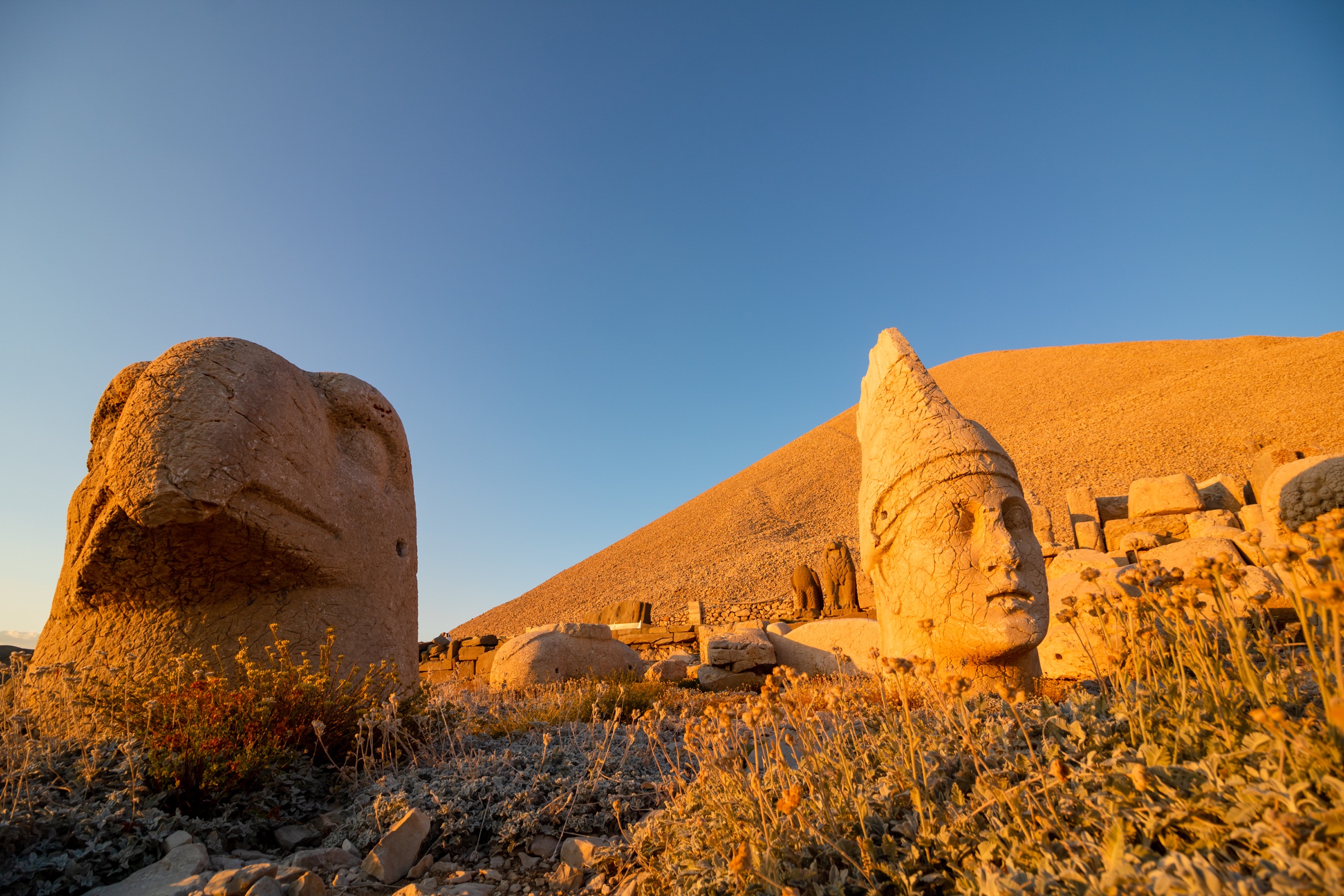
Nemrut Dağı is the Hierothesion—temple-tomb and house of the gods—that Antiochus I of Commagene raised for himself in the first century BCE. It is not a lost city. It is a ceremonial landscape designed to project lineage, power and eternity.
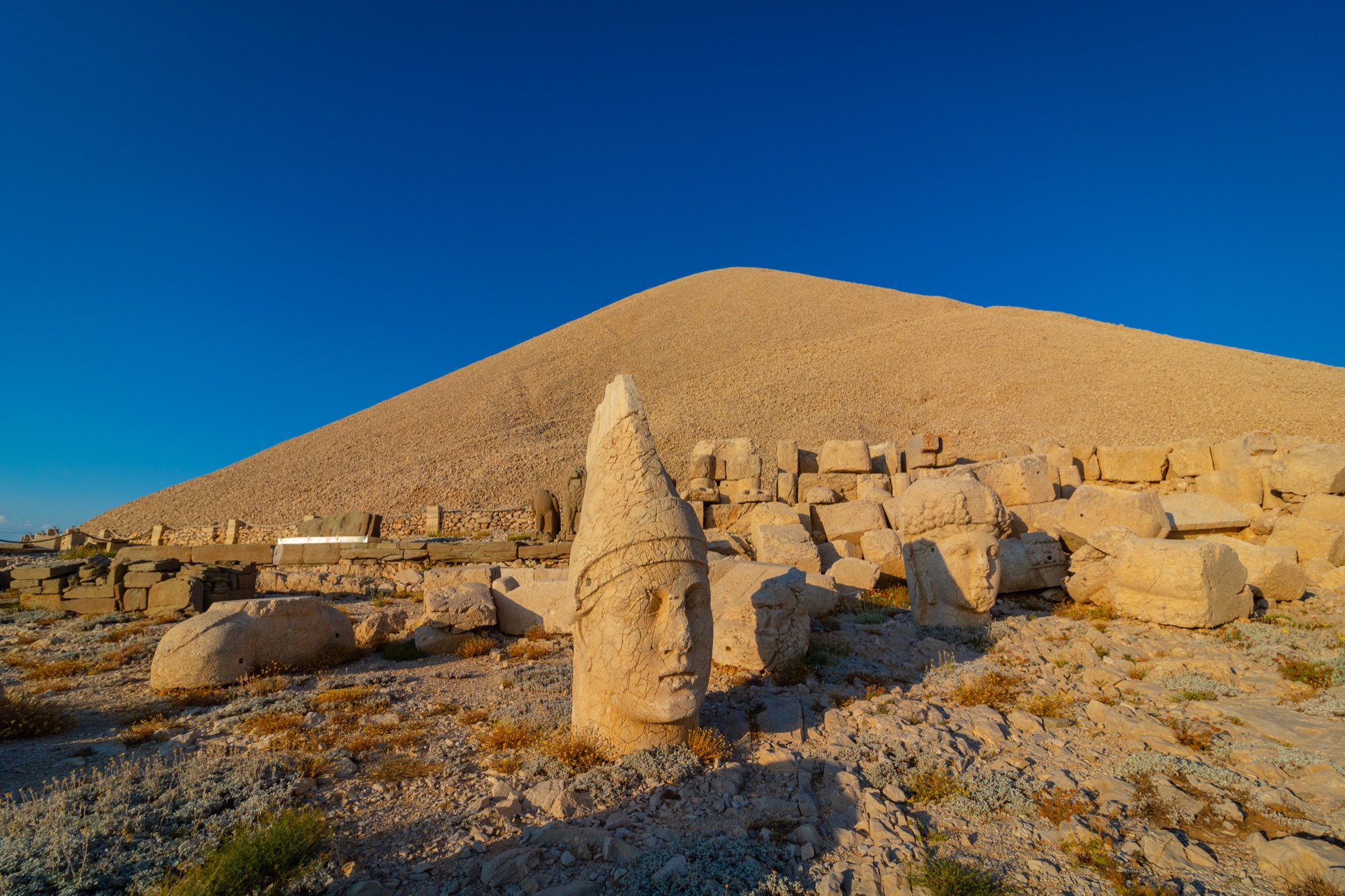
A crushed-stone tumulus roughly 50 metres high and 145 metres wide crowns the mountain. Around it, terraces facing east, west and north held colossal statues, altars, genealogical reliefs and inscriptions.
- BUILDER
- Antiochus I of Commagene
- DATE
- 1st century BCE
- ELEVATION
- c. 2,150 m
- UNESCO
- World Heritage since 1987
- TYPE
- Royal Hierothesion
- COORDINATES
- 37.981° N · 38.741° E
A kingdom between empires.
Mithridates I founds independent Commagene between Seleucid, Roman and Parthian spheres.
Reign of Antiochus I. The king develops a religious programme joining Persian and Macedonian genealogies.
The tumulus, terraces and colossal images turn the summit into a dynastic sanctuary.
Engineer Karl Sester reports the monumental statues; modern investigation begins.
Theresa Goell and Friedrich Karl Dörner begin systematic research. Study and conservation continue.
Three sides of a sacred mountain.
East terrace
The most formal composition: colossal thrones, stepped altar and figures facing sunrise. The great Nomos inscription defines the cult.
West terrace
The same figures face sunset. Dexiosis reliefs show Antiochus greeting gods; the so-called lion horoscope was also found here.
North terrace
A long narrow space with pedestals, probably connected to ceremonial movement between the two principal terraces.
The tumulus
Millions of limestone fragments form an artificial cone. The burial chamber attributed to Antiochus has not been conclusively located.
A political pantheon in stone.
Antiochus I
The king sits among the deities: the central image of his political legitimacy.
Commagene / Tyche
Personification of the fertile land and kingdom itself.
Zeus-Oromasdes
Zeus joined with Ahura Mazda: Greco-Persian synthesis made divine.
Apollo-Mithras-Helios-Hermes
A composite solar god carrying names and identities from several traditions.
Artangnes-Heracles-Ares
Iranian and Greek martial power combined in one figure.
WHAT WE KNOW
Inscriptions identify the builder, deities, ancestors and rules of the royal cult.
WHAT IS DEBATED
The tomb’s exact location, construction sequence and astronomical reading of the lion relief.
WHAT WE DO NOT KNOW
There is no evidence for supernatural “energy” or lost technology; scale came from organisation, stonework and royal power.
What Hancock does—and does not—say about Nemrut.
Unlike Göbekli Tepe, Mount Nemrut has no central, clearly documented role in Hancock’s published Ice Age lost-civilisation hypothesis. Attributing a specific theory about this monument to him would be invention.
A historically identified monument
Nemrut was built in the first century BCE, roughly nine millennia after Göbekli Tepe. Inscriptions name Antiochus, his gods, ancestors and cult rules. There is no chronological gap requiring an unknown prehistoric culture.
Astronomy, syncretism and memory
The lion relief, solar orientation and fusion of Persian and Greek traditions fit themes Hancock often explores: celestial knowledge and cultural transmission. That invites comparison, but comparison is neither a claim by Hancock nor evidence of an Ice Age tradition.
Documented royal propaganda
The cultural mixture is not mysterious: Commagene stood between Roman and Parthian worlds. Antiochus turned that political position into sacred genealogy, joining Darius and Alexander and seating himself among double-named gods.
Nemrut is powerful precisely because its author and intent are unusually visible. Here documented history is more extraordinary than a lost-world theory: a small kingdom built an entire political cosmology on a mountain.
How to visit Mount Nemrut.
SEASON
Snow generally closes the summit road for much of the year. The official tourism source normally gives mid-April to mid-October; verify before departure.
SUNRISE OR SUNSET
Both are famous, but mean darkness, wind and low temperatures. Carry a headlamp and warm layers even in summer.
ACCESS
Karadut, Kahta or Adıyaman are practical bases. A demanding high-altitude walk remains beyond the parking area.
COMMAGENE ROUTE
Pair the summit with Arsameia, Karakuş Tumulus and Cendere Bridge to understand the kingdom beyond the heads.
FAQ
Were the heads carved separately?
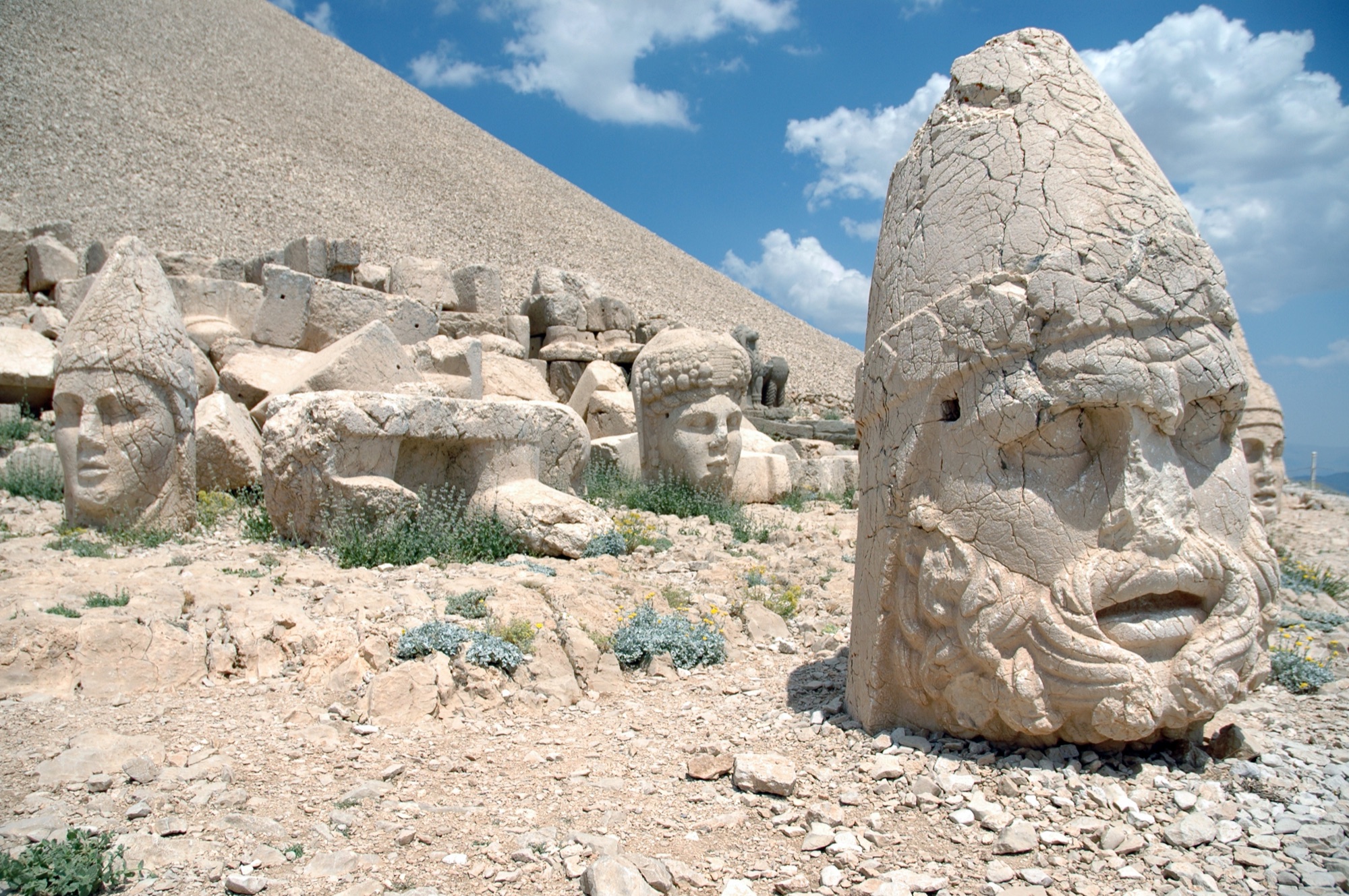
No. They originally belonged to seated statues eight to ten metres high. Earthquakes, weather and freeze-thaw cycles contributed to their fall and decay.
Is Antiochus buried inside the tumulus?
The monument was conceived as his tomb-sanctuary, but the burial chamber has not been conclusively located.
What cultural mixture does Nemrut represent?
Its programme combines Persian and Macedonian genealogies, Greek and Iranian divine names and a distinctly Commagenian Anatolian aesthetic.
Can you drive up all year?
Do not assume so. Snow commonly closes the summit road; verify official access and local weather.
The evidence behind the story.
UNESCO World Heritage Centre
↗02Türkiye Ministry of Culture and Tourism
↗03Adıyaman Provincial Culture Directorate
↗04ICOMOS evaluation
↗Editorial review: 27 August 2026