
ANATOLIA · 9600–8200 BCE
GÖBEKLİ
TEPE
Before pottery, cities and Stonehenge, Neolithic communities raised monumental architecture here. The extraordinary story needs no myths.
A place that changed the question.
Göbekli Tepe is not simply “the world’s oldest temple”. That phrase shrinks a far more interesting site. Across this nine-hectare human-made mound, monumental buildings existed alongside flint-working, consumption of wild animals, everyday activity and a powerful symbolic life.
The question is no longer only why hunter-foragers built monuments. It is how communities in northern Mesopotamia experimented with gathering, memory, shared labour and new ways of living at the opening of the Neolithic.
- DATE
- c. 9600–8200 BCE
- LOCATION
- 15 km NE of Şanlıurfa
- ELEVATION
- c. 770 m
- UNESCO
- World Heritage since 2018
- LANDSCAPE
- Germuş Mountains
- COORDINATES
- 37.2232° N · 38.9224° E
Two millennia on one hill.
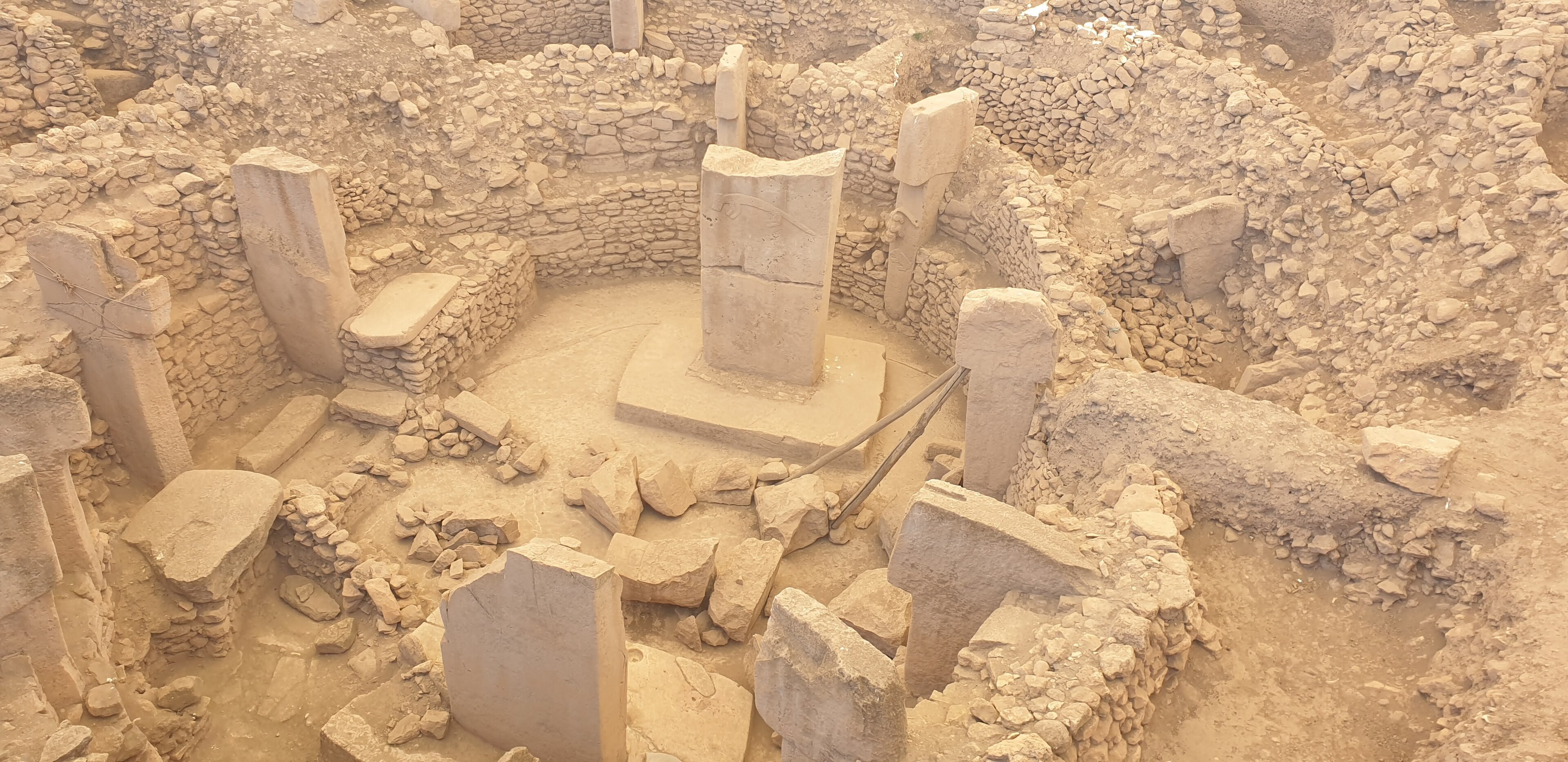
Large round or oval special buildings with T-pillars appear.
Buildings are rebuilt; feasting, craft and imagery leave material traces.
Rectangular plans become common and pillars generally smaller.
Occupation ends. Fills combine human and natural processes.
Recorded in a Turkish-American survey, rediscovered in 1994 and excavated since 1995.
Anatomy of a special building.
The central pillars
They reach roughly 5.5 metres; those in Building D weigh an estimated eight to ten tonnes.
Figures, not posts
Arms, hands, belts and loincloths show several T-forms represent anthropomorphic beings.
A carved bestiary
Foxes, boars, snakes, birds and felines appear in relief. Their meaning remains open.
Stone from the hill
The limestone plateau was quarry and worksite; monoliths moved without metal or draught animals.
Evidence before spectacle.
WHAT WE KNOW
- Dating combines radiocarbon, tool typology and stratigraphy.
- T-pillars deliberately carry human traits.
- Domestic activity occurred beside communal or ritual buildings.
WHAT IS DEBATED
- The exact function of each building.
- Whether some spaces were roofed.
- What animals and signs meant.
NOT PROVEN
- That it was an observatory or star map.
- That a lost civilisation intervened.
- That everything was buried in one ritual.
From isolated “temple” to complex settlement
New work on buildings, tools and everyday activity broadens the first interpretation: a settlement with a strong communal and ritual component. The revision makes it more human.
It was not alone
Göbekli Tepe belongs to Taş Tepeler, the “Stone Hills” of Şanlıurfa. Karahantepe and other sites reveal a regional network, not an anomaly dropped from the sky.
Skulls, death and memory
Three cranial fragments carry deliberate incisions and one a perforation: possible skull-cult treatment, but not evidence of sacrifice.
How to visit Göbekli Tepe.
BEFORE YOU GO
Check hours, tickets and closures on Türkiye’s official museums portal; these vary seasonally.
AT THE SITE
Allow at least 90 minutes and study the relationship between pillars, walls and benches.
WEATHER
The plateau is exposed to sun, wind and cold. Carry water and protection.
BY MOTORCYCLE
The final approach is paved. Şanlıurfa is the logical fuel and accommodation base.
Questions without sensationalism.
Is it the world’s oldest temple?
That label is too certain. It has some of the oldest known monumental buildings, but their function remains under study.
Was it built by hunter-gatherers?
Its earliest phases belong to communities at the opening of the Neolithic, as sedentism and cultivation transformed the region.
Is it older than Stonehenge and the pyramids?
Yes, by several millennia. That gives chronological scale, not a cultural connection.
Has all of it been excavated?
No. Most of the mound remains unexcavated, and geophysics indicates more structures.
The essential library.
UNESCO World Heritage Centre
↗02Göbekli Tepe Research Project · DAI
↗03Science Advances · modified human crania
↗04UNESCO nomination dossier
↗05Museums of Türkiye
↗Editorial review: 27 August 2026